

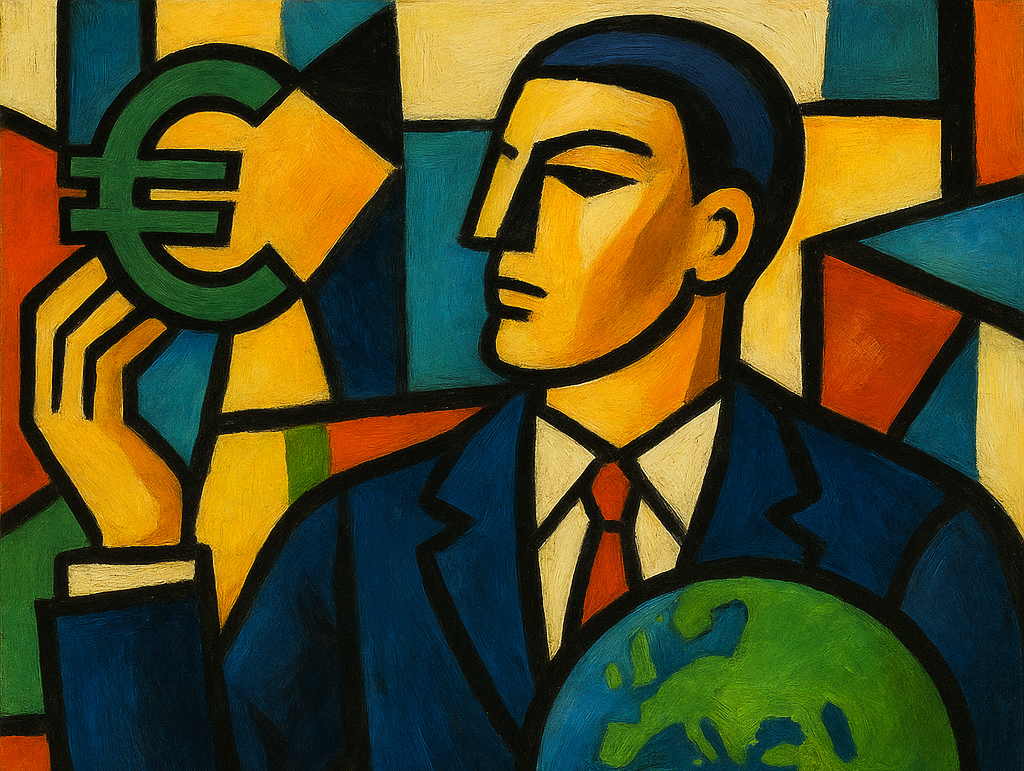
Why we must learn to think together in an age of accelerating machines
We are living in the paradox of intelligence.
On the one hand, machines are accelerating beyond comprehension — learning, predicting, generating. Artificial intelligence is hailed as the next revolution, a new general-purpose technology reshaping economics, culture, and even identity.
On the other hand, human intelligence is fragmenting. Trust is in retreat. Loneliness is rising. Our ability to hold complexity, bridge perspectives, and govern together is eroding — precisely when it is needed most.
The mismatch is glaring. We are scaling systems without scaling sense-making.
Machines race ahead, humans fall behind
Consider the numbers. Generative AI systems are doubling in capability every 6–12 months. Capital investment in AI surpassed $50 billion in 2023, and its projected impact on global GDP runs into the trillions. Yet surveys show that less than 30% of citizens trust their governments to manage these transformations. Meanwhile, one in four adults reports feeling lonely according to the OECD — a signal of disconnection that corrodes democratic resilience.
We are building faster systems on shakier foundations. And that dissonance has consequences. As the World Health Organization notes, loneliness carries health risks equivalent to smoking 15 cigarettes a day. In parallel, polarization and disinformation are eroding governance. When coherence collapses, intelligence fragments — no matter how much processing power we outsource to machines.
The result? Exponential technology meets eroded human collaboration.
“We are scaling systems without scaling sense-making.”
The limits of technical fixes
When institutions confront complexity, their instinct is often to regulate, codify, or outsource. In the AI debate, we hear calls for algorithmic audits, international treaties, and red-button fail-safes. All necessary, perhaps. But insufficient.
The deeper challenge is not technical. It is relational.
How do we make decisions across borders, cultures, and generations? How do we balance innovation with responsibility, speed with deliberation, local knowledge with global frameworks? How do we rebuild trust when every institution is under suspicion?
The economist Elinor Ostrom once warned that commons fail not because of scarcity, but because of failed governance — the breakdown of cooperation rules. AI and climate change are not just technological or environmental issues. They are governance commons problems. And commons problems are solved not by sharper tools, but by stronger collaboration.
Collaboration as a higher intelligence
If intelligence is the ability to solve problems, then collaboration is the ability to solve shared problems.
Neuroscience shows that human cognition is not solitary but distributed. We think better in groups that challenge and support us. History shows the same: the breakthroughs that shifted civilizations — from the Renaissance to the Internet — were the product of networks, not individuals.
And yet, our economic models prize competition over collaboration. Our politics reward polarization. Our technologies amplify division for profit.
To thrive in the 21st century, we must elevate collaboration as a form of intelligence — equal in value to machine computation, and superior in its ability to sustain coherence across human systems.
This requires investment not only in external technologies, but in what the Inner Development Goals call the inner technologies of awareness, listening, perspective-taking, and humility. Without them, AI will accelerate dysfunction as easily as progress.
Building architectures of trust
If collaboration is intelligence, then trust is infrastructure. Without trust, collaboration collapses into transaction; without collaboration, intelligence collapses into noise.
Encouragingly, there are experiments under way. The World Economic Forum’s Global Collaboration Village, launched in 2023 with partners like Microsoft and Accenture, is exploring digital spaces for cross-border dialogue. At the governance level, the UN’s Sustainable Development Goal 17 places “Partnerships for the Goals” as essential to achieving every other target. Research by the Stockholm Resilience Centre underlines that resilience is always a function of diversity and connectivity, not centralization alone.
These are not utopias. They are prototypes. They show that collaboration can be designed, practiced, and scaled. But they also show how fragile the work is when incentives are misaligned.
From ego-systems to ecosystems
Otto Scharmer of MIT speaks of moving from “ego-systems” to “eco-systems.” The phrase captures the shift required: away from zero-sum competition toward positive-sum collaboration. In practice, that means:
– Embedding multi-stakeholder governance in AI development.
– Creating economic metrics that reward trust-building, not just profit-taking.
– Elevating collaborative intelligence in schools, corporations, and civic life.
– Designing digital platforms that foster dialogue rather than division.
At Bluerain Partners, we frame this as coherence: ensuring that human systems scale in ways that remain intelligible to the humans inside them. We support initiatives that integrate technology with community, finance with purpose, and leadership with humility.
Collaboration is survival strategy
The point is not soft idealism. It is survival strategy.
The Intergovernmental Panel on Climate Change warns that governance fragmentation is as dangerous as temperature rise. The AI Now Institute cautions that without global cooperation, AI development will amplify inequality and instability. The evidence is stark: disconnection kills systems, whether ecological or social.
Longevity, biodiversity, climate, and technology all share the same root problem: we treat them as technical challenges when they are relational challenges. And relational challenges demand collaboration as their core intelligence.
Toward coherence
So where do we go from here?
We begin by recognizing that the most valuable intelligence of the 21st century is not artificial, nor even human in isolation. It is collaborative intelligence: the ability to hold difference, build trust, and co-create coherence.
That requires leaders who are fluent not only in finance and technology, but in listening and bridging. It requires institutions that prize resilience over short-term metrics. It requires cultures that teach children not only how to code, but how to collaborate across worlds.
Because collaboration is not the soft skill of tomorrow. It is the hard infrastructure of survival today.
***
About Bluerain *Coherence* Series
This essay is part of a broader collection exploring how valuation, healthspan, collaboration, longevity, and biodiversity can be re-aligned with the rhythms of life — at a pace that enables regeneration rather than exhaustion.
The purpose of this compendium is to:
– Contribute meaningfully to public discourse on systems change and intergenerational strategy
– Offer fresh language and framing for leaders navigating complexity
– Share what we are learning, unlearning, and building in real time
We welcome dialogue, respectful critique, and collaboration — to deepen a shared understanding of what it means to steward coherence in a time of disruption.
For inquiries or conversation, please reach the author via linkedin.com/in/martinstuder.
About the Author
Martin Studer is an entrepreneur and impact investor focused on sustainability and longevity. Trained as an economist and certified public accountant, he brings decades of leadership experience in finance, governance, and executive management. As founder of Bluerain Partners, a Swiss family office, he works globally on projects spanning climate resilience, healthspan innovation, and intergenerational stewardship.
About Bluerain Partners Group
Bluerain Partners Group AG is a privately held, multi-generation family office headquartered in Switzerland. We do not offer commercial services or raise external capital, while some of our subsidiaries may do.
Our work is anchored in long-term purpose, driven by the belief that meaningful progress requires curiosity, collaboration, and courage.
We engage globally in projects that span climate resilience, health span and longevity, and the evolving nature of work and technology. We do so through investing, advising, governance, and venture development — always with an emphasis on coherence across generations, disciplines, and geographies.
These essays are authored by Martin Studer in a personal capacity. They reflect his experience, reflections, and aspirations — and may not necessarily represent the formal positions of Bluerain Partners Group AG, its subsidiaries, affiliated projects, or partners.
info@bluerainpartners.com.