

Our Perspectives
Explore our comprehensive approach to sustainable business development across four key domains that shape the future of regenerative commerce.
Price and Prayer
By Martin Studer - July 2026
Price and Prayer
By Martin Studer - July 2026
Guiding the Future
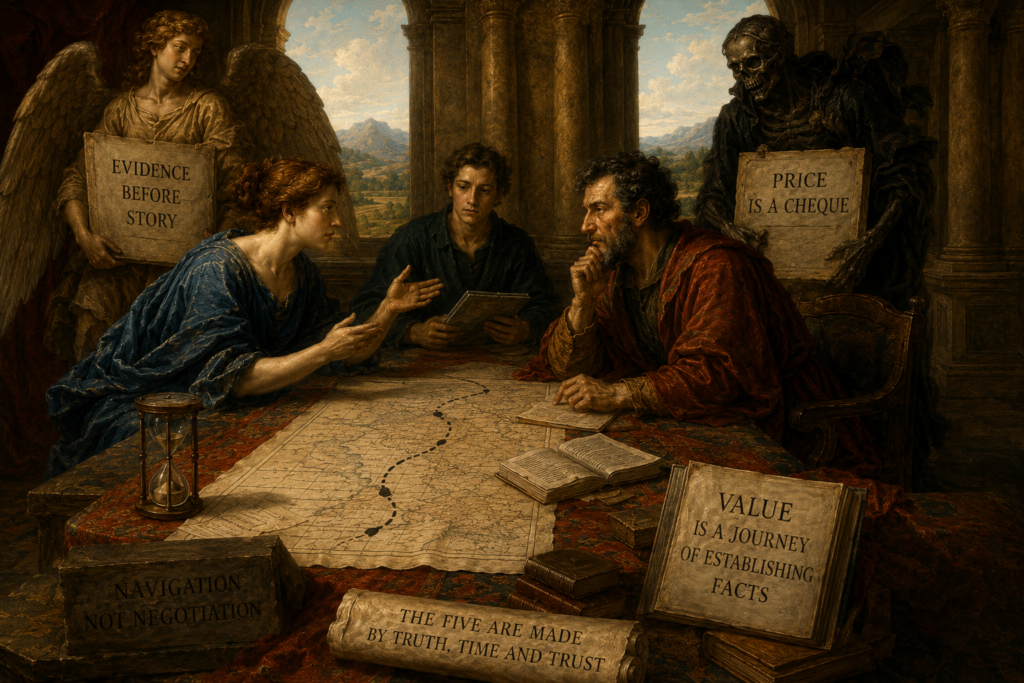
Most ventures do not make it, and we cannot even count them properly, because the counting starts after capital has already chosen. Here is what nobody at the table dares to say: the founder does not believe the valuation on the slide, and the investor does not believe it either. One is performing certainty. The other is pricing the odds of losing everything. So we haggle over a price for something that does not exist yet, and call it raising capital. But price is a cheque. Value is a journey of establishing facts. Build the evidence first, sell the equity second. That is the road out of the many and into the few. It is why we built VALUATE™. It is why price and a prayer will never get you to shore, and disciplined valuation will.
The Aging Voter and the Unborn Counterparty
By Martin Studer - May 2026
The Aging Voter and the Unborn Counterparty
By Martin Studer - May 2026
Guiding the Future

In most developed economies, the median voter is now over fifty. The median person who will live with the consequences of today’s capital allocation decisions is not yet voting, and in many cases is not yet born. This asymmetry is a structural feature of democratic capitalism in the late industrial age, and it has significant consequences for how nature gets priced, by whom, and on what timeline. The essay refuses two wrong turns, moralising the aging voter and stepping away from democracy in favour of more forceful governance, and argues instead for a strengthened direct-democratic civic culture as the response. A second structural stressor is named: concentrated market power over information.
The Cooperation of Adversaries
By Martin Studer - April 2026
The Cooperation of Adversaries
By Martin Studer - April 2026
Guiding the Future

Robert Axelrod’s 1984 tournament is widely cited in sustainability writing as evidence
that cooperation will emerge once players recognise the long game. This essay argues that
the plain-vanilla reading misfits the ESG conversation in a specific way: the system is
iterated, but the actors inside it are not. Politicians play to the next election, civil servants
to the end of their mandate, executives to the length of their tenure. The gap between the
system’s horizon and the actor’s horizon is the principal-agent problem at civilisational
scale, compounded by overlapping prisoner’s dilemmas that create epistemic cover for
defection.
Bounded Openness
By Martin Studer - February 2026
Bounded Openness
By Martin Studer - February 2026
Guiding the Future

In recent years, and particularly at the World Economic Forum in Davos in 2026, it has become clear that the central question facing contemporary capitalism is no longer whether markets create value, but whether they can remain legitimate under conditions of structural constraint. What is increasingly described as ‘ethical capitalism’ is not a departure from market economics, but its necessary evolution: a form of capitalism capable of sustaining trust, competition, and productivity in a world shaped by geopolitical fragmentation, technological acceleration, and physical limits. The fading of ESG as a dominant narrative does not signal a retreat from responsibility, but a transition from declarative compliance toward the harder task of embedding social, ecological, and political constraints directly into the functioning of markets themselves.
From Chaos to Truth
By Martin Studer - January 2026
From Chaos to Truth
By Martin Studer - January 2026
Guiding the Future

Boards rarely fail because data is missing.
They fail because bad news travels slowly, incentives distort narratives,
complexity creates plausible deniability, and confidence is mistaken for
correctness.
That is where assurance proves its existence.
Not in reports.
But in whether decision-makers change how they understand risk, trade-offs,
and consequences.
From a board governance perspective, this is what I hope the next generation
of internal auditors and other assurance providers will embody:
Independent assessment is not a governance complication.
A Market that tells the Truth
By Martin Studer - January 2026
A Market that tells the Truth
By Martin Studer - January 2026
Guiding the Future
As the World Economic Forum convenes once again in Davos, much attention will be given to resilience, climate risk, geopolitical fragmentation and confrontation, artificial intelligence, and the future of capitalism itself. These conversations matter. But they often circle around the symptoms rather than the underlying design challenge.
The core question is not whether markets should lead or whether states should intervene more forcefully. The deeper issue is whether the signals that guide market behaviour still reflect reality.