

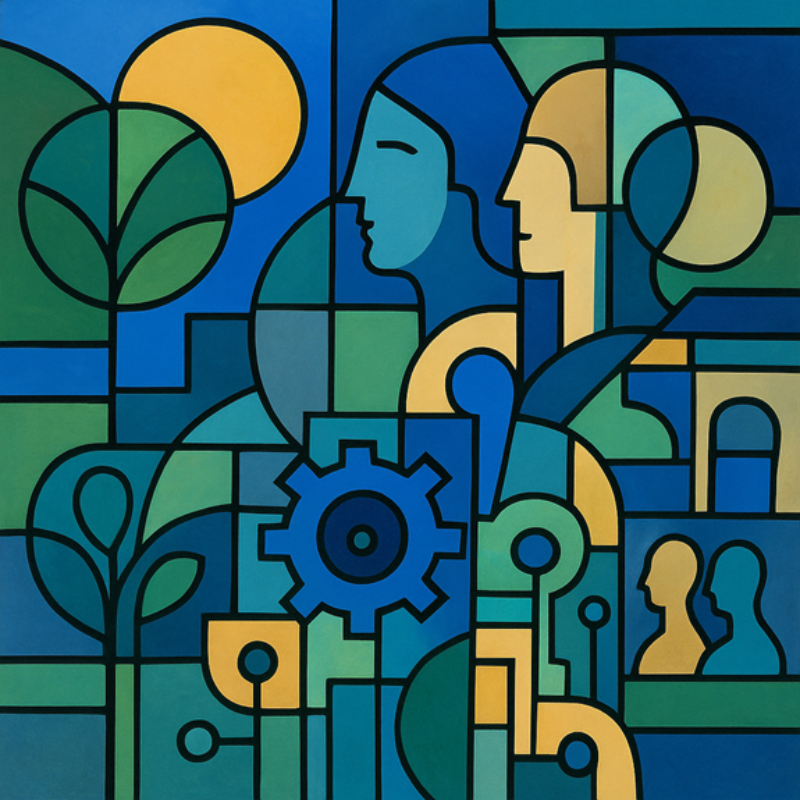
Why the convergence of ecology, demography, and technology marks not collapse, but a starting point
A starting point, not an epitaph
Future generations may look back at this decade not as the time of collapse, but as the moment when their ancestors recognised that three great transformations were converging — and chose to align them.
The language of “poly-crisis” dominates political and academic discourse. It describes the sense that every system is under stress at once: climate, energy, migration, inequality, governance. It is a diagnosis of simultaneity, meant to capture the feeling of being overwhelmed.
But words matter. “Poly-crisis” sounds like pathology, as if history itself were breaking apart. It is more useful — and more truthful — to call it a “starting point”. What looks like breakdown is also the beginning of a new form of coherence, if we choose to see it that way.
We are entering an era shaped by three mega-complexes: ecological destabilisation, demographic transformation, and technological acceleration. Each is formidable on its own. But their real force lies in how they interact. The challenge is not to isolate them, but to navigate their convergence.
Ecological destabilisation
The ecological complex is no less visible than the technological one — but far more irreversible. Global warming has already passed the 1.5°C threshold, but not uniformly. Switzerland has warmed by 2.7°C; parts of Sweden are already beyond 4°C, with glaciers receding at alarming speed. Biodiversity is collapsing: the Stockholm Resilience Centre’s planetary boundaries framework shows we have already exceeded safe thresholds for species integrity, nitrogen cycles, and land use.
This shows up in disrupted harvests, floods, droughts, wildfires, and migration pressures. The World Bank estimates that climate change could displace over 200 million people by 2050, while other sources guide on closer to 1 billion for every 1°C warming. Insurance companies are quietly retreating from entire geographies, pricing risk in ways that hint at uninsurability.
For decades, financial reporting has treated ecosystems as externalities. Forests were assets only when cut. Rivers became costs only when polluted. Yet the truth is simpler: ecological stability is infrastructure — the base of equity and solvency. Without it, no economy functions. Without it, no polity endures.
Demographic transformation
If ecology is our outer environment, demography is our inner fabric. Humanity is aging. In advanced economies, one in three citizens will be over 65 by 2050. Global fertility rates are falling. Longevity gains are widening the gap between lifespan and healthspan.
The OECD projects soaring healthcare costs and shrinking workforces. In Sweden, nearly half of sickness-related absences are due to stress or mental illness. In the United States, dementia care already costs over $300 billion annually. These are not side issues: they are central to productivity, resilience, and intergenerational cohesion.
At the same time, migration will reshape demographics. Europe’s future population distribution will depend not only on fertility rates, but also on flows of people trying to escape the heat, seeking security, skills, and purposeful contribution. Societies that integrate newcomers into meaningful economic and civic roles will be more dynamic and sustainable than those that exclude them.
Here lies the heart of the demographic challenge: it is not just about adding healthy years, but about stretching and retaining productivity deeper into the lifespan. Pension and social systems were designed at a time when average life expectancy barely exceeded retirement age. Now, many live 20 or more years past that threshold. This cannot balance without either eroding future welfare or reducing intergenerational equity and ecosystem integrity.
New ways of financing aging societies must emerge — not by extracting more from the young, but by extending vitality, re-skilling midlife, encouraging entrepreneurship, and redesigning systems for longer productive engagement.
Technological acceleration
The third complex is technological. Artificial intelligence, automation, synthetic biology, and quantum computing are advancing at exponential pace. Capital investment in AI alone surpassed $50 billion in 2023, with projections of trillions in GDP impact by 2030.
Yet governance lags. Less than one-third of citizens globally trust their governments to manage these transformations responsibly. Disinformation corrodes institutions. Social media platforms fragment attention and amplify outrage. Workplaces strain under cognitive overload.
The risks are real: inequality, surveillance, destabilisation. But so are the opportunities: breakthroughs in medicine, efficiency in energy use, new forms of collaboration. The question is not whether technology will accelerate, but whether societies will embed it in coherence rather than chaos.
The nexus: convergence as destiny
Each mega-complex is daunting. But the deeper reality is that they do not act in isolation. Their power is in interaction.
– Climate migration collides with aging societies and AI-driven labour shifts.
– Energy transition faces demographic shift and technological disruption.
– Healthspan erosion is amplified by attention economies and ecological stress.
It is at these intersections that risks compound — but also where solutions can emerge. And solutions will require more than incremental reform. They will demand new societal systems and infrastructure.
The concepts and structures of the past — from industrial-age pension models to nation-state governance to fossil-fuel finance — must be challenged. Around the world, experiments are under way: Chinese and Indian megacities grappling with scale, or Saudi Arabia’s Neom project probing the limits of engineered design. Some may fail, others proof validity. But together they point to a global search for coherence at scale.
The rising metropolis of the north
Where might this convergence be navigated most dynamically in Europe?
Based on multi-variable economic modelling — climate resilience, demographic trends, technological capacity, governance quality, and societal trust — the 200-kilometre circle around Greater Copenhagen is poised to become the rising metropolis of the north.
Here, northern Europe gathers many of the conditions the future requires: political stability, high trust, strong research institutions, renewable energy leadership, cultural openness, and a geography less exposed to extreme climate risk than many others.
This does not mean immunity. It means potential. In the decades ahead, this circle could become one of the most dynamic development zones in the northern hemisphere — not despite turbulence, but because of it.
And what of Mundekulla, my own base in Sweden? It sits at the periphery of this circle, not its centre. It may become part of this metropolis, but for now it is a laboratory. A place where nature-based business models — syntropic farming, food forestry, regenerative enterprise — are tested. A place that nurtures regenerative wellbeing as much as economic productivity. And a place embedded in civic society, experimenting with how communities and institutions can be partners in renewal.
The coherence compass
How do we navigate the convergence of ecology, demography, and technology? Not with isolated fixes, but with a compass.
At Bluerain, we describe it as EIG: Ecology, Integrity, Generativity.
– Ecology reminds us that every ledger sits inside living systems. Nature is not an externality; it is the base of equity and solvency.
– Integrity demands that disclosures, governance, and incentives align with reality, not optics. Compliance is necessary, but coherence requires more.
– Generativity asks whether our actions create conditions for life to flourish — leaving communities, ecosystems, and future generations stronger than before.
This compass is not a technical checklist. It is a practice of coherence. It can guide capital allocation, policy design, business models, and cultural priorities alike.
Beyond compliance
This brings us back to accounting — not only in the financial sense, but in the civilisational one. Current reporting systems comply with their rules, but the
rules themselves leave prices misaligned with reality. Externalities are unpriced, healthspan unvalued, social trust unrecorded.
The end goal is not to make business unprofitable. On the contrary: it is to organise business in a free and liberal market economy while internalising ecosystem services — so that profits cover three essentials:
– Compensating for risks taken.
– Investing for future growth and innovation.
– Building reserves for resilience across generations.
Together, these three functions define profitability that is both credible and durable. It is how value is built into the future by those with skin in the game — risk-takers, entrepreneurs, investors, families — not by bureaucrats alone.
“Accounting is about what we choose to count — and what we choose to ignore.”
A call to stand into potential
We stand, then, not in a poly-crisis but at a poly-crossroads. Ecological destabilisation, demographic transformation, and technological acceleration are converging. The choice is how we meet them.
If we see them as pathology, we will shrink into fear. If we see them as invitation, we will not shrink from the heat but will step into coherence.
The rising epicentre of the north offers one vantage point: a place where these forces may be integrated into a new pan-national form of prosperity. Other regions will have their own paths. The point is not geography alone, but mindset.
The task before us is clear: to design systems that can hold together across turbulence. To measure what matters, invest in regeneration, and lead as if the seventh generation were watching.
Future generations may forget our names. But they will live inside the structures we build — or the ruins we leave behind. That is legacy enough.
***
Author’s note: A version of this essay was first presented as a keynote at Jönköping International Business School (Sweden) in August 2024.
About Bluerain *Coherence* Series
This essay is part of a broader collection exploring how valuation, healthspan, collaboration, longevity, and biodiversity can be re-aligned with the rhythms of life — at a pace that enables regeneration rather than exhaustion.
The purpose of this compendium is to:
– Contribute meaningfully to public discourse on systems change and intergenerational strategy
– Offer fresh language and framing for leaders navigating complexity
– Share what we are learning, unlearning, and building in real time
We welcome dialogue, respectful critique, and collaboration — to deepen a shared understanding of what it means to steward coherence in a time of disruption.
For inquiries or conversation, please reach the author via linkedin.com/in/martinstuder.
About the Author
Martin Studer is an entrepreneur and impact investor focused on sustainability and longevity. Trained as an economist and certified public accountant, he brings decades of leadership experience in finance, governance, and executive management. As founder of Bluerain Partners, a Swiss family office, he works globally on projects spanning climate resilience, healthspan innovation, and intergenerational stewardship.
About Bluerain Partners Group
Bluerain Partners Group AG is a privately held, multi-generation family office headquartered in Switzerland. We do not offer commercial services or raise external capital, while some of our subsidiaries may do.
Our work is anchored in long-term purpose, driven by the belief that meaningful progress requires curiosity, collaboration, and courage.
We engage globally in projects that span climate resilience, health span and longevity, and the evolving nature of work and technology. We do so through investing, advising, governance, and venture development — always with an emphasis on coherence across generations, disciplines, and geographies.
These essays are authored by Martin Studer in a personal capacity. They reflect his experience, reflections, and aspirations — and may not necessarily represent the formal positions of Bluerain Partners Group AG, its subsidiaries, affiliated projects, or partners.
info@bluerainpartners.com.