

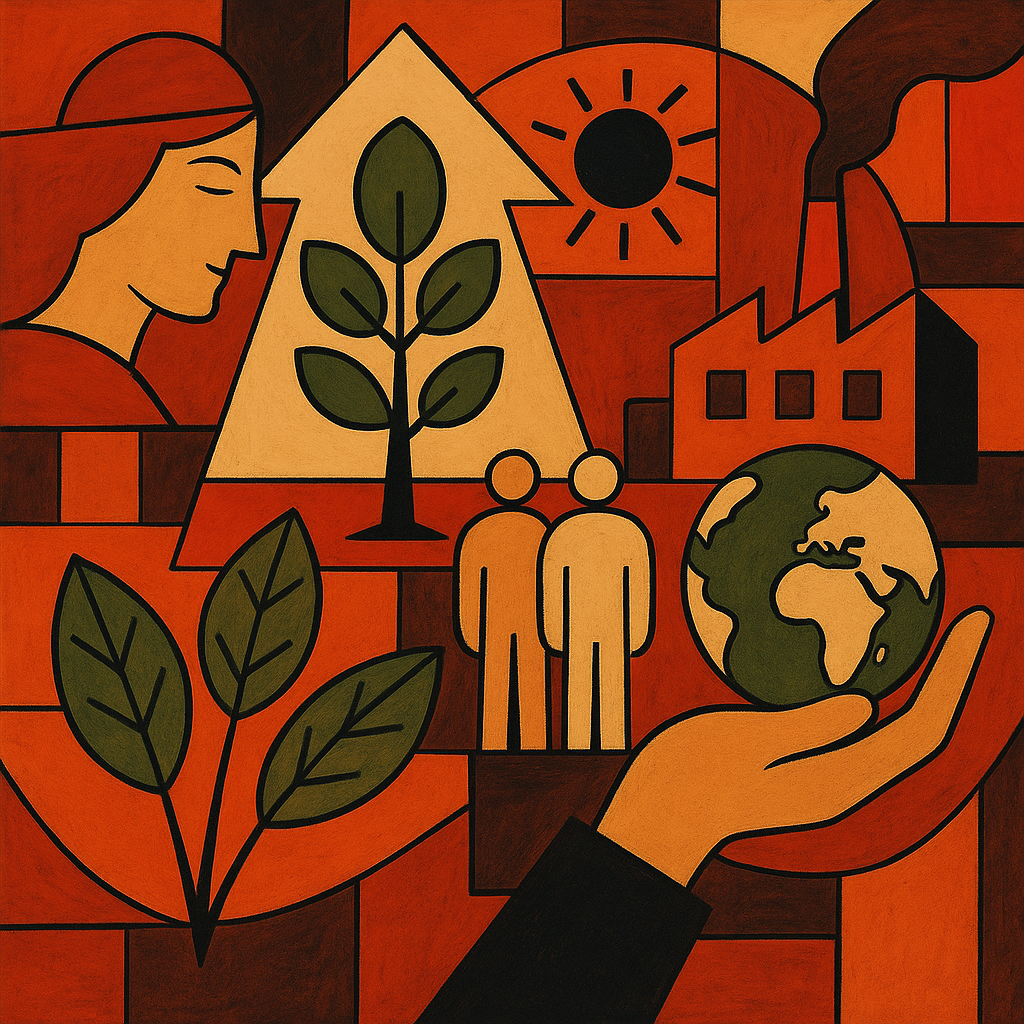
A Business Case for Ecosystem-Conscious Growth
When I was twelve, I read The Limits to Growth. I remember closing the book with a knot in my stomach. That evening I asked my father if the world might really be running out of time.
He smiled and said, “Someone will fix it, Martin. It will be alright.”
Half a century later, I know he was only half right. It will be alright—if we choose to fix it ourselves.
That lesson returned years later in a boardroom. As a young consultant I once told a CEO, “Your business will be sustainable when you internalise every external effect that isn’t priced—and still make a profit.”
He banged the table. “If that’s sustainability, you can close every business on earth.”
He was expressing what many still feel: concern without a compass. The real question is how companies can remain profitable and meaningful without damaging the systems that make profit possible.
Awareness Is Not Enough
We have never been more informed. Every corporate deck now includes slides on sustainability, circularity, biodiversity and social trust. Yet awareness alone does not move markets; agency does.
Firms that treat ecosystem services as a management competence—not a communications theme—are already ahead. They win on efficiency, on trust, and increasingly on margins. The stability of any enterprise depends on the stability of the systems beneath it: water, soil, energy, individual wellbeing and social cohesion.
This is not a moral debate. It is a managerial one—and therefore solvable.
From Heroes to Swarms
The Swiss explorer Bertrand Piccard once told, “Talk ecology to industrialists and you’re called a utopian; talk industry to environmentalists and you’re branded a capitalist. The future demands we overcome this divide.”
He contrasts the hummingbird—fighting a forest fire with a single drop of water—with the piranha—thousands acting together, changing the river itself. Transformation seldom comes from heroes; it comes from coordination. A thousand small, synchronised actions are stronger than one grand gesture.
The Swedish municipality of Växjö likes to call itself “Europe’s Greenest City.”
More than 90 per cent of its heating now comes from renewable sources, and the city’s carbon emissions per capita have fallen by half since the 1990s.
What began as a civic choice has become a competitive advantage.
Businesses in the region have followed suit—installing solar panels, switching to bio-based fuels, redesigning production lines for energy efficiency.
For many, the motivation was not virtue but volatility: energy security, lower operating costs, and a clearer story for customers who increasingly ask where the power behind their products comes from.
They did not wait for subsidies; they acted.
That is what leadership looks like. The difference between the three per cent who lead and the ninety-seven per cent who follow is rarely resources—it is consistency. Optimism is not a mood; it is a management style.
Problem-Talk Exhausts; Solution-Talk Energises
Leadership today means resisting the addiction to crisis. We do not have a knowing problem; we have a doing problem.
The technologies to halve emissions and close material loops already exist. What’s missing is deployment at scale and speed.
Efficiency, circularity, clean innovation and wellbeing are not costs to profit; they are its next chapter.
The mindset shift is simple:
Not either/or—both/and.
Not moralism—modernisation.
Not compliance—competitiveness.
The Neighbourhood Principle
Offsetting emissions in distant places is easy. Repairing impact where we actually operate—where emissions happen and communities feel them—is harder, but far more legitimate.
Boards should ask: Are we off-shoring responsibility, or building trust at home?
Neighbourhood compensation ties corporate survival to local wellbeing. It builds social licence that no certificate can buy. Saying we offset globally is yesterday’s language; saying we restore locally will define tomorrow’s credibility.
In Småland, a timber company recently restored a wetland to stabilise its own water supply. The result was healthier forests and fewer community conflicts. Repair what sustains you: trust is built next door.
Regeneration by Design
Industries built on extraction change only when their interests change. The task is to design those interests.
Make regeneration profitable; make circularity secure supply chains; make efficiency increase market share.
At Bluerain Partners and Mundekulla, we pursue this logic through a forest-based business model that links landowners with companies seeking near-shore climate compensation. Forests become managed infrastructure for carbon, biodiversity and learning. Landowners earn stable income for preservation. It is not philanthropy—it is iteration.
Nature offers the blueprint: adaptive, self-correcting, cooperative. As the late Dr Jane Goodall reminded us, empathy is intelligence. Organisations that behave like ecosystems—diverse, responsive, regenerative—prove more resilient than those optimised for extraction alone.
Modernisation, Not Sacrifice
We are not being asked to give things up; we are being asked to grow up—as leaders, as markets, as a species.
Resources that once felt infinite now carry consequence. Growth is no longer about speed; it is about coherence. To be modern today is to understand the system that carries you.
I have stopped using the word sustainable—it has become too small. The real question is what is regenerative: what feeds life rather than drains it.
When energy savings become strategy, when trust becomes capital, when collaboration outperforms competition, we are not becoming idealists—we are simply catching up with reality.
My own compass has three points: Ecology, Integrity, Generativity.
- Ecology—because none of us operate outside the living world.
- Integrity—because coherence matters more than compliance.
- Generativity—because what we leave behind is as real as what we build.
The Swedish Lesson
Sweden has long been a laboratory for doing more with less. From Småland’s glassworks to global cleantech, constraint became creativity. That instinct—pragmatic optimism—is the country’s quiet advantage.
It proves that progress begins not with more, but with meaning. And meaning is the raw material of innovation.
The Call
Modernisation is not a checklist; it is an awakening—an ecosystem of businesses learning to work with the world that holds them, not against it.
Leadership now means aligning what we promise with what we practise, what we take with what we give back, success with stewardship.
The future will not reward scale alone. It will reward alignment. Because the economy that endures will be the one that regenerates.
***
About Bluerain *Coherence* Series
This essay is part of a broader collection exploring how valuation, healthspan, collaboration, longevity, and biodiversity can be re-aligned with the rhythms of life — at a pace that enables regeneration rather than exhaustion.
The purpose of this compendium is to:
– Contribute meaningfully to public discourse on systems change and intergenerational strategy
– Offer fresh language and framing for leaders navigating complexity
– Share what we are learning, unlearning, and building in real time
We welcome dialogue, respectful critique, and collaboration — to deepen a shared understanding of what it means to steward coherence in a time of disruption.
For inquiries or conversation, please reach the author via linkedin.com/in/martinstuder.
About the Author
Martin Studer is an entrepreneur and impact investor focused on sustainability and longevity. Trained as an economist and certified public accountant, he brings decades of leadership experience in finance, governance, and executive management. As founder of Bluerain Partners, a Swiss family office, he works globally on projects spanning climate resilience, healthspan innovation, and intergenerational stewardship.
About Bluerain Partners Group
Bluerain Partners Group AG is a privately held, multi-generation family office headquartered in Switzerland. We do not offer commercial services or raise external capital, while some of our subsidiaries may do.
Our work is anchored in long-term purpose, driven by the belief that meaningful progress requires curiosity, collaboration, and courage.
We engage globally in projects that span climate resilience, health span and longevity, and the evolving nature of work and technology. We do so through investing, advising, governance, and venture development — always with an emphasis on coherence across generations, disciplines, and geographies.
These essays are authored by Martin Studer in a personal capacity. They reflect his experience, reflections, and aspirations — and may not necessarily represent the formal positions of Bluerain Partners Group AG, its subsidiaries, affiliated projects, or partners.
info@bluerainpartners.com.